


TIP OF THE ICEBERG: ABUSE and COURAGE

By Dr. Rita Fierro and Dr. Eddie Moore Jr.

Sexual abuse trigger self-care warning: We’re not going to get graphic in this article, partially because we have no reason to, and partially because as a survivor, I, Dr. Rita, have been walking a line to not get triggered myself. So, a reminder to take care of yourself.
Here’s a cool self-care article you can keep in mind and three easy steps if it gets overwhelming or simply if you notice body reactions like faster breathing or your heart pounding:
1) Stop reading. Come back later, if/when it works to.
2) Calm your body. There are lots of strategies, choose the ones best for you. Even a glass of water can help.
3) Be self-compassionate. When we’ve been through something, even small things can poke us strongly. Time to reward ourselves for surviving, not condemn ourselves for the pain and anxiety that come up when our mind and bodies remember.
***
Us simple folks have a deep-gut feeling that the lives of the rich and famous are not just out of reach, but that they have something, something profound and inaccessible that’s completely different from us. It’s a weird feeling that we could never truly mix with that world even if our skin color, wardrobe, and way of speaking didn’t set us apart. We don’t quite know what the “it” is that would have us stand out like oil on water, what truly would make us unmixable, forever recognizable as the common folks we are. All we do know is that there is something “they” have that is so extraneous to who “we” are that it’s beyond our wildest imagination.
The Epstein scandal strengthens this feeling of separation. We are learning that there is a lot more to the thick layer of privilege amour that separates “them” from “us.” The picture has taken on horror film traits: the well-networked world of the rich, famous, and powerful is not only incapable of empathy towards the world of common folks, but also the world of children in a way the generates deep, visceral disgust.
In the face of the horrors of sexual violence we believe and support the survivors—aware that fake accusations of sexual abuse bring victims no benefit in a patriarchal society. There are no benefits to lies, given that it takes all we got to stand up for the truth.
The Epstein scandal has gotten so big it feels grave not to mention with another Women's History Month recently behind us and at a time when the majority of victims are still, women. We honor the victims, all the victims, with full knowledge that what it takes to survive and make meaning of such experiences is super tough, and sets us on a track that requires almost a lifetime to fully integrate and process. We honor the courage it takes to live, stay alive, and learn to thrive, the courage it takes to speak one’s truth and live by it.

The Epstein files are having resignations and arrests run like waterfalls around the world. From the Dubai’s DP World’s CEO replacement,, to the Prime Minister of Norway getting immunity revoked and charged with corruption, resigned Norwegian ambassador to Iraq, Slovakia’s national security adviser, chairwoman of the United Nations High Commissioner for Refugees (UNHCR). Some investigations are still in process such as: French ex-Culture Minister, Lithuanian businessman.
The UK has taken action faster, with arrests (and release on bail) of the former Royal Prince, former Labour minister, and resignations of prime minister’s chief of staff, and communications director, U.K.’s ambassador to the U.S. Perhaps we have some lessons to learn from the UK on elite impunity and accountability, as this The Guardian article suggests.
Nationally, the arrests haven’t happened yet, having us question exactly how loose is our sense of accountability yet some cascade of resignations, is happening here, too, Goldman Sachs Legal Officer, Harvard’s president, chair of the School of Visual Arts, chairman of the high-powered law firm, former Senator chairman of the Mitchell Institute, former Senator chairman of the clean-energy company, advisory board of Cambridge Judge Business School, Columbia University cut ties with Two Drs from its Dental School, executive chairman of Hyatt Hotels, CBS contributor from Columbia University’s neuroscience institute, a former treasury secretary, president of World Economic Forum.
Many in the Trump administration were named, but face no consequences as of yet: Commerce Secretary Howard Lutnick, Centers for Medicare & Medicaid Services Dr. Mehmet Oz, Steve Bannon, Deputy Defense Secretary Stephen Feinberg, Elon Musk, for a total of half a dozen of current administration officials. Also, as the recent New York Times reveals, there was a thick network of elite doctors: in what seems like an exchange of investment in medical structures in exchange for illicit procedures.
Or course, among these people, per our legal system, everyone is innocent until proven guilty in a court of law, yet, we all know, that if not everyone, someone is certainly guilty.
In the face of such vast impact, there is a deep feeling that all of this sick network that is surfacing is simply the tip of the iceberg. Of course, it’s always tempting to see such a corrupted world as exclusively belonging to those of tremendous privilege and power, but we can’t stop there. Given our commitment to antiracism, we must ask ourselves some tough questions about power, whiteness, and the state of our civilization. There are some questions we need to pose ourselves about whether this violence is actually relegated to the world of the rich and powerful or if it’s more a reflection of the disregard from human dignity frequent in our times.
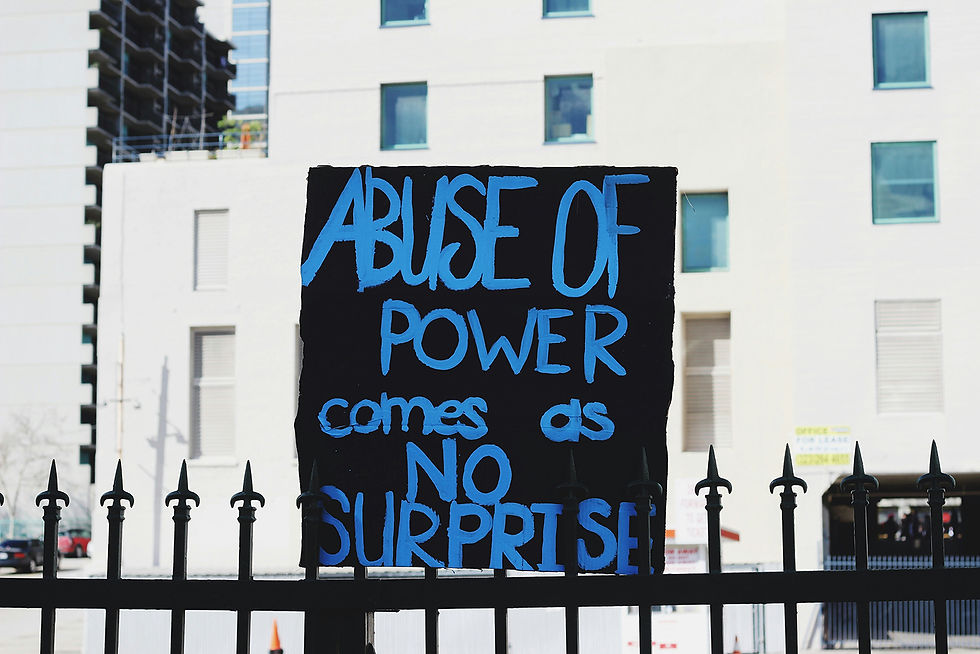
Given our commitment to unpacking whiteness and white supremacy, we must see the issue within a greater lens––paying attention to the corruptions of western civilization that is aggravating these mechanisms of distorted, corrupted power in the western world.
We put forward two approaches to expand this lens, one, on the fact that the repetition of trauma is frequent, and two on how many Indigenous societies were able to avoid the proliferation we see today. We offer up trauma-psychiatrist Dr. Sandra Bloom and Australian Aboriginal researcher, educator, and thinking Tyson Yunkaporta as experts here. Both of their analyses highlight how the obsession of the western world with privacy and suppression, expand the worst of humanity.
Dr. Bloom is an expert in how organizations and societies reenact trauma. She has done extensive research on how communities and organizations tend to repeat trauma––in psychiatry it’s called repetition compulsion. Some spiritual approaches see the repetition as an opportunity to heal, to transform, because life often presents us with multiple opportunities to shift and free ourselves from that which hurts us the most.
You can find her four-part series online on: Neither liberty nor safety: The impact of fear on individuals, institutions, and societies (Bloom, 2004, 2005, 2006). Dr. Bloom, highlights that one of the reasons we witness the rise child abuse, is because western societies have eliminated many of the rituals that Indigenous societies used to maintain a state of balance between what was considered “good” and “evil.”
“The objective of tribal religions is to establish a balance, a harmony between various supernatural forces that encircle human beings and this is done through ceremonial ritual.” (Bloom, 2003, p5).
“Indigenous healing groups deal with the experience of suffering, misery, and healing through staged reenactments… The healing ceremony is almost always a public and collective procedure involving family, tribe, and members of a special healing society.” (Bloom, 2007, p188).
In a different publication that I’m struggling to find, she speaks specifically to pedophilia, saying that in Indigenous societies there were public rituals to enact the attraction of adults towards children, and the public nature of it all, rendered it safe. Reduced to public dances, not sex, these attractions and fantasies had ways to be expressed and controlled at the same time. In this case, complete suppression favors abuse.
In Sandtalk, Tyson Yunkaporta highlights how whiteness considers violence dirty and unacceptable in everyday interactions, while displacing it most violently in the worlds of people of color, both nationally and internationally: he says that whiteness relegates violence to the shadows, pretending to have nothing to do in its white-bubble worlds while its societal structure has historically been the most violent around the world. By contrast in Indigenous societies: “There is a big difference between controlled, public violence, and uncontrolled, private violence.” (Yunkaporta, 2020, p188) As an example, he says, if two women are contesting the same man, the fight happens publicly, and the person who wins rarely kills, precisely because they are being witnessed by the whole community. “If there is a dispute,” he says, “everybody is involved, and if violence is used then it is highly ritualized and witnessed by all.” (Yunkaporta, 2020, p189)

These considerations, have us ask ourselves, deeper questions about the culture we support that seems to be expanding and generating abuse, despite our best attempts at shutting it down. Perhaps one of the causes is our clutch-our-pearls reaction to sexual violence. And the vicious duality that Lillian Smith points out: “Though your body is a thing of shame and mystery…whiteness is a symbol of purity and excellence.” (Smith, 1949, p89) We are raised in the paradox of identifying white bodies with purity on one hand, and total shame on the other. In the sick whiteness notion of projecting all fears, violence, emotions, and desires on folks of color, accusing others of doing what white plantation owners were doing. We actually expanded the worst of humanity, claiming it did not belong to white folks--while violence and depravity on plantations and in colonial occupations grew. And that the movement of Black women, for centuries, has been saying that all this violence, required healing, for all parties involved.
The first steps in this sense, are to cease the scapegoating of folks of color, breaking the shame cycle on our bodies, and the silence everywhere and stop pretending to not see, to not hear, to not witness, not only once the abuse has happened, but as we watch it precipitate.
For when a child is mistreated, it would be really false to say, no one noticed.
Once we’ve broken these silences, perhaps we can start rebuilding and rethinking the rituals it will take to bring our societies back to the practices of good and away from evil, away from compulsive trauma-reenactment that diminishes not only the humanity of the victim, but of the predator, as well.
References (Abuse and Courage)
Bloom, S. L. (2003). Trauma and the nature of evil. CommunityWorks. 2-34.
Bloom, S. L. (2004). Neither liberty nor safety: The impact of fear on individuals, institutions, and societies, Part I. Psychotherapy and Politics International, 2(2), 78–98.
Bloom, S. L. (2004). Neither liberty nor safety: The impact of fear on individuals, institutions, and societies, Part II. Psychotherapy and Politics International, 2(3), 212–228.
Bloom, S. L. (2005). Neither liberty nor safety: The impact of fear on individuals, institutions, and societies, Part III. Psychotherapy and Politics International, 3(2), 96–111.
Bloom, S. L. (2006). Neither liberty nor safety: The impact of fear on individuals, institutions, and societies, Part IV. Psychotherapy and Politics International, 4(1), 4–23.
Bloom, S. L. (2007). Loss in human service organizations. In L. A. Vargas & S. L. Bloom (Eds.), Loss, hurt and hope: The complex issues of bereavement and trauma in children (pp. 142–206). Cambridge Scholars Publishing
Smith, L. T. (1994). Killers of the dream. W. W. Norton & Company.
Yunkaporta, T. (2020). Sand talk: How Indigenous thinking can save the world. HarperOne.


